
Thursday, May 9, 2013
Monday, January 7, 2013
Cairo is like a troubled heart

The pyramids were not built to mimic the stars for nothing. I always wanted to see the Great Pyramid of Giza but I had no idea that my life would be changed forever upon entering. I had dreams of light for days after my arrival and a new sense of direction that I hadn't known for months.
Yes, I'm gushing, but don't be deceived. It is not a comfortable place. Not by a long shot. As a tourist I was hassled and hustled for money everywhere I turned - and despite my stubborn sense of haggling and the few Arabic words I picked up in Dubai: la, shukran (no, thank you) - good quality Egyptian products can empty the pockets quicker than you can say 'pharoah'.
Despite the revolution I never felt unsafe or threatened during two recent trips to Cairo. In fact I found the locals open-hearted and incredibly helpful once you get past the sales pitch and connect with them as people. It's not always as easy as you might think though, because the Egyptian oils, cotton, papyrus and trinkets can be enchanting in their own way - and the Egyptians are intuitive. If you're interested to buy they won't leave you alone.
Food can be tricky too, but luckily I have a strong stomach. Perhaps growing up in Africa helps. In general cooked food is recommeded, in order to get rid of bacteria. Or simply choose a trusted local restaurant such as Barry's in Giza or the popular falafel chain Felfela, which is dotted all over the city. Egyptian falafel (mashed bean fritters) is made in the form of a patty. The falafel, flat bread, salads and dips are generally listed separately on the menu and meant to be enjoyed mezze style as opposed to the falafel sandwich. Make sure to add some grilled eggplant and tahini to the spread for a unforgettable flavour combination.
Many people advised me not to travel to Cairo alone as a woman, but when I went back for a second visit after an organised tour, I felt confident that, with a responsible attitude, there would be no reason to fear. I had a trusted contact in Cairo who organised my airport pick-up and new friends to ask for advice and assistance, especially since I'm not fluent in Arabic. Of course, local customs such as covering up should be respected at all costs. I wore long sleeves with skinny jeans (In Egypt the issue is with showing skin, not curves) and pashminas and never felt disrespected while walking around in the city. In general, the less skin you show in public, the more respect you receive.
Ah, just look at the soft pink sunset over the pyramids from the balcony of Yasmina of Cairo's Bed & Breakfast. I sat there mesmerised for hours. Somehow, somewhere amongst all of the dirt and the dust there is a beautiful energy that shoots straight for the heart. Everything in life doesn't always have to make sense. I am simply grateful for the magic that is Cairo.
If you would like to find out more about the Bed & Breakfast with the beautiful balcony, email Yamina at: yasmina@yasminaofcairo.com

Sunday, October 28, 2012
Waking up to a winter wonderland and porcini on toast

I've been out and about in the snow to run errands over the weekend and quickly learned that a hat with a rim and a good coat work better than an umbrella or a beanie when it snows. The rim of a hat keeps the snowflakes from getting into my eyes (believe me, it hurts!) and, since it's too cold for the ice to melt, I can simply 'dust' off the snowflakes on my coat whenever I reach my destination.
Last night when I walked home after dinner with friends, the sidewalk was already covered in snow dust and I also noticed a thick layer of snow icing the autumn leaves and cars outside. So this morning I couldn't wait to see the winter wonderland in the daylight. It's the season's first snow and it's fairy tale pretty.
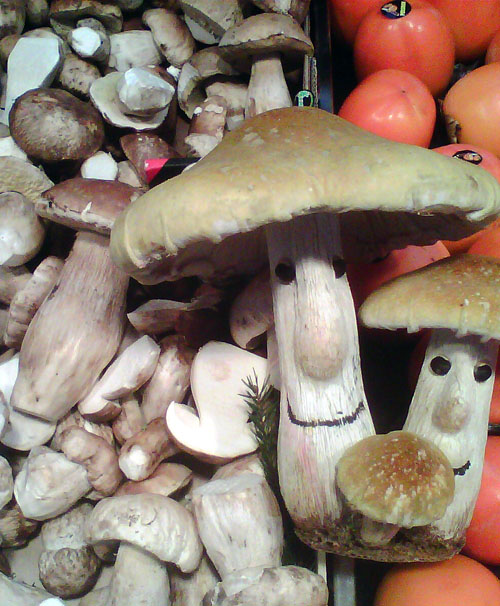 One of the greatest pleasures about living in Europe is the seasonal ingredients I can pick up at the open air markets on my way through the central city. Seasons are truly embraced here in Bavaria and meals (even restaurant menus) are planned around the local ingredients available at the time. At the moment porcini mushrooms abound and you can also pick them in the forests yourself if you know what to look for.
In Germany they are called Steinpilz (stone mushrooms) and I love how the vendor around the corner from my office carves little characters into his porcini display.
This morning I celebrated the snow with some of the mushrooms I bought from this stall, sautéed in butter and relished on toasted Bauernbrot (farmer's rye bread) for breakfast. Apparently these mushrooms also have powerful anti-viral properties, which is a perfect health perk for me as my body gets used to this sudden drop in temperature.
Everything is so quiet when it snows. Almost like a hush that highlights special moments such as unwrapping the brown paper from my fresh porcino mushrooms and savouring the aromas as it melts into the butter - and later, in my mouth.
I've saved a few mushrooms for making pasta later so I can set off its earthy, nutty flavours with a glass of red wine, or a little grappa, as the afternoon unfolds.
Wednesday, October 10, 2012
Rollercoasters and bubbles at the Oktoberfest

However, there's a whole festival going on outside the tents, with rollercoasters and games, as well as food and wine and cocktail stalls spread out across the Therisienwiese festival grounds.
I can't help thinking that it might be a bit dangerous to walk underneath those rollercoasters.Just because I can imagine how I would feel up there after a couple of those massive beers. However, I do think the rollercoaster riders are probably well regulated by the German officials. Still, better safe than sorry.

I didn't make it to the Weinzelt this time unfortunately. Perhaps because I haven't made too many wine drinking friends in Munich. I've also been told that that the wine crowd can be quite schiki-micki (snooty) - but, hey, if someone wants to think I'm posh because I like to drink bubbles, then that's totally ok.
It is, in fact, a relief to see women all around the Wiesn standing around with glasses of wine and bubbles from the stalls. I do tend to agree with my Cape Town friends who insist that wine and bubbles are a lot more feminine than beer.
They were horrified to hear that I drink beer in Munich: "But, uhm, that's just not very sexy at all!"
I've been throwing myself into the Munich beer culture in order to experience the city in a truly authentic way. While I still struggle with the jugful quantities I find that I actually like dark beers most. It really is a special experience to sit in a beer garden under the chestnut trees, or at a beer tent at the Oktoberfest trying to master the Maß.
And yet, I'm still a wine aficionado at heart.
Saturday, October 6, 2012
Oktoberfest party at the Paulaner

Not that we sit down for long. The reservation is for around 4pm and after the first round of beer, a host of Bavarian snacks makes it to our table, including cold roasted pork, sausages, cheese, radish, horseradish and gherkins. Of course, there is also the giant bredzels to go with those giant beers. Who knows where these Germans put it all! The food keeps on coming: roast chicken, cheese Spätzle (a dumpling style German pasta), Knödel (a large round potato dumpling served with brown sauce) and Kaiserschmarrn (a sweet shredded pancake topped with raisins and a sifting of icing sugar).
 In true German style, we all politely finish our meal before jumping onto our table and dancing to the foot stomping beat of the brass Oompah band. The girls all have cute little beer mug accessories (as in the photo above) so that they can easily pick out theirs from the line-up. These mugs are heavy, so you have to put them down every now and again, especially while dancing - and it helps to find yours again when it's colour coordinated with your outfit.
Listening to German music usually makes for a good way to practice my language skills, but these songs are pretty elementary - 'now we jump, now we swim, now we all hold hands', etc.
"Yes, it is almost like music for children - because when us Germans drink lots of beer we think like children," my Bavarian friends comment, while following the communal moves to what seems to be an Oktoberfest favourite.
It's really funny how cheesy a lot of German music is. Dramatic love songs are highly esteemed. I also find out that the popular song 99 Red Balloons was originally recorded in German, as 99 Luftballons by the band Nena. The Oompah band plays a whole lot of songs with mock lyrics set to popular tunes. I even pick up a few South African favourites such as Laurika Rauch and Miriam Makeba - although the German versions are naughtier than the originals.
By the time the tent closes at 10pm, I've had more than my fill of food and beer and fun - but of course, no true Bavarian party is complete before a shot of schnapps. It's a killer, but at least I can say I survived Oktoberfest with the locals.
Sunday, September 30, 2012
Inside the Hofbräu tent at Oktoberfest

As Hofbräu is probably the most internationally famous of Munich's six main breweries, this tent is generally known to be frequented by international Oktoberfest visitors. My Australian friend feels right at home and I also spot some of my American and British expat friends around - it is not everywhere in Munich where you hear that much English! The Hofbräu tent is also one of the first beer tents on entering the Oktoberfest grounds so getting stuck in there with a Maß (one litre beer mug) or two isn't unlikely, even for the local Bavarians.
 While some people are very particular about which tents to go to and book their favourite spots months in advance, we are lucky to get a table at all, at any tent for that matter. The Hofbräu tent can accommodate up to 10 000 people inside and it's pretty crowded. Outside in the beer garden around the tent there's a bit more breathing room and its the perfect spot to sit down for a bite to eat. I am also happy to notice that the food prices here are not inflated for the event and it is possible to find some decent Bavarian food at the same prices as you would at the beer gardens around town.
My Thai friend Pree doesn't really drink alcohol but in the spirit of the Oktoberfest she agrees to try a Radler, a half-half mix of beer and locally made lemonade. In fact, even Rebecca makes big eyes at the Maß and we all decide on an easy start. Radler is also served in a one litre mug and it's the only way really for me to keep up with the beer drinkers.. It goes down well with our shnitzel, which arrives with a hearty serving of Bavarian potato salad and red currant preserve.
Soon the girls are green with dirndl envy. Yes, when you're sitting there in your jeans and everyone else is wearing pretty Bavarian dresses you do feel somewhat out of place. And especially when everyone is having so much fun, it is even more tempting to get into character and jump on that table to dance along with the rest. On a Sunday most shops in Bavaria are closed but for Oktoberfest emergencies such as this, there are a few shops and stalls selling dirndls and lederhosen around the Hauptbahnhof.
What fun seeing them transform into Bavarian goddesses! There's yet another few days of Oktoberfest ahead!
Tuesday, September 25, 2012
Oktoberfest is both savage and beautiful
 I'm surprised. Oktoberfest is not just about drunk men passing out in ditches. Of course, that's there too - but there are many other really lovely things about the festival. Even if you don't like beer.
Top of my list are the costumes. The costumes, the costumes, the costumes. Besides the fact that Bavarians love to dress up in Medieval outfits for festivals, the Oktoberfest is probably best known for the 'tracht' or traditional dress.
For women this is the dirndl, a corset-like dress worn over a short blouse and accessorised with an apron. Older ladies from the Bavarian countryside often still wear this as an everyday outfit - and it is especially popular at formal occasions such as weddings or the church on Sunday.
During the Oktoberfest and other traditional festivals in the area, young girls also embrace the tradition and start planning their outfits months in advance.
 Men wear lederhosen, which is simple raw leather shorts with suspenders (in the picture on the left two savages in their lederhosen are taking part in the hunters' parade). Bavarian men especially like to wear their traditional dress as a habit and it has become somewhat trendy, even amongst youngsters.
Guys often wear their lederhosen around town, at beer gardens - and to watch Bayern Munich play footie. As much as I'd like to be able to make fun of it, there's no denying that these pants really do look quite good on a sporty male figure.
Bavarians are very proud of their history and traditions. It simply takes a walk around Munich city centre to see the selection of designer dirndl shops, Bavarian food markets and, well, beer gardens. This deep love for their culture is also reflected in the popular parades during the launch weekend of Oktoberfest, where various traditional outfits are showcased.
 What fascinates me even more than the outfits, are the hair styles, hats and hair accessories. There are plaits in all colours, shapes and sizes, a lot of silk and velvet ribbons, flowers, feathers, shiny beaded headdresses and even pom-poms. Unless Bavarian ladies learn special hair styling skills from a young age, the hairdressers in Munich must be really busy over the Oktoberfest time.
 Since Bavaria is a strict catholic society, a lot of locals are not really fond of the tourist perception of Oktoberfest. Though it brings in a lot of money for the city, the Wiesn (as Oktoberfest is known amongst the locals) is a proud celebration of traditional culture.
It is originally meant to be a family occasion and you can still find activities for young and old around the festival grounds. From merry-go-rounds to scary rides, a host of delicious food options, sweet snacks and trinkets - as well as a large agricultural exhibition with a host of farm animals which is very popular with children.
"During Oktoberfest things happen in this city that never normally happen in this city," people like to say, with an annoyed shake of the head.
So, you can tart up the dirndl and pass out in a ditch if you like, but it will make you one of those less than favourable 'things'. Not that the locals don't do sexy. There are so many different dirndl styles, shapes and accessories that it allows just about any woman to channel her inner goddess.
Subscribe to:
Posts (Atom)


